Description
Triple Receptor Mechanism Profile
Retatrutide is scientifically notable for agonist activity at three metabolically relevant receptor systems: GCGR, GIPR, and GLP-1R. These receptors participate in distinct but interconnected endocrine and metabolic signaling pathways.
Experimental activation of these receptors can influence intracellular signaling, nutrient-responsive pathways, and energy-regulation mechanisms. By incorporating activity at all three receptors within one molecule, retatrutide provides researchers with a model for studying integrated multi-receptor signaling.
This triple-agonist profile distinguishes retatrutide from research compounds focused primarily on a single incretin receptor or dual-receptor combination.
These mechanisms describe areas of scientific investigation and should not be interpreted as therapeutic claims for this research product.
Retatrutide Molecular Research Profile
Retatrutide is a synthetic peptide engineered to interact with the glucagon, GIP, and GLP-1 receptors. Its molecular design is intended to permit experimental investigation of three receptor pathways within a single peptide framework.
Glucagon, GIP, and GLP-1 are naturally occurring peptide hormones involved in nutrient-responsive and endocrine signaling. Their receptors are distributed across multiple tissues and participate in complex physiological communication networks.
Synthetic multi-receptor agonists such as retatrutide allow researchers to investigate how simultaneous receptor activation may alter signaling patterns compared with selective or dual-receptor agonism.
Why Retatrutide Is Studied
Retatrutide has generated substantial scientific interest because its triple-receptor profile provides a platform for investigating interactions among glucagon, GIP, and GLP-1 signaling. Research areas include receptor pharmacology, cellular signaling, endocrine regulation, nutrient-response pathways, energy-balance mechanisms, and comparative incretin research.
Researchers may compare retatrutide with single- or dual-receptor research compounds to characterize differences in receptor activation and downstream molecular responses.
These investigations contribute to the broader understanding of multi-receptor peptide biology and metabolic signaling.
GLP-1 Receptor Research
The GLP-1 receptor is a G-protein-coupled receptor extensively investigated in metabolic and endocrine research. GLP-1 is an endogenous incretin hormone released in response to nutrient intake.
Retatrutide’s activity at GLP-1R enables researchers to examine this pathway in combination with GIP and glucagon receptor signaling. Laboratory studies may evaluate receptor activation, intracellular signaling, and downstream cellular responses under controlled conditions.
This combined approach can help researchers characterize how GLP-1 receptor signaling behaves within a broader multi-receptor experimental model.
GIP Receptor Research
GIP, or glucose-dependent insulinotropic polypeptide, is an endogenous incretin hormone that interacts with the GIP receptor. GIPR signaling is an active area of research involving nutrient-responsive and endocrine pathways.
Retatrutide provides GIP receptor agonist activity together with GLP-1 and glucagon receptor activity. This enables comparative research examining GIPR signaling both as an individual pathway and as part of a multi-receptor system.
Experimental studies may investigate receptor activation, signaling kinetics, and interactions among incretin-related pathways.
Glucagon Receptor Research
The glucagon receptor is another G-protein-coupled receptor involved in metabolic and endocrine signaling. Endogenous glucagon participates in physiological pathways associated with nutrient availability and energy regulation.
Retatrutide’s activity at GCGR makes it scientifically distinct from dual GIP/GLP-1 receptor agonists. Researchers can investigate how glucagon receptor signaling interacts with simultaneous GIPR and GLP-1R activation.
This provides an experimental framework for studying integrated receptor pharmacology and downstream metabolic signaling.
Multi-Receptor Research Significance
The defining research characteristic of retatrutide is simultaneous activity at three receptor targets rather than one or two.
From an experimental perspective, this allows comparison among selective receptor activation, dual-receptor signaling, and triple-receptor signaling involving GCGR, GIPR, and GLP-1R.
Such studies can help characterize receptor interactions, intracellular signaling differences, and downstream biological responses associated with increasingly complex peptide-receptor profiles.
Laboratory Research Applications
Retatrutide may be investigated in appropriately designed laboratory research involving receptor pharmacology, peptide biology, and metabolic signaling.
- Triple-receptor research: Investigation of combined GCGR, GIPR, and GLP-1R activation.
- Receptor pharmacology: Characterization of peptide-receptor interactions and signaling behavior.
- Cell signaling: Study of intracellular pathways following receptor activation.
- Incretin research: Investigation of GIP and GLP-1 receptor-related pathways.
- Glucagon receptor research: Experimental characterization of GCGR signaling within a multi-receptor model.
- Comparative peptide research: Comparison with single- and dual-receptor research compounds.
- Endocrine and metabolic research: Investigation of molecular pathways involved in nutrient-responsive and energy-regulation signaling.
These represent scientific research categories and are not recommendations for clinical, veterinary, or personal use.
Vial Specifications
|
Property |
Specification |
|
Product Name |
Retatrutide |
|
Brand |
Sigma Bionics |
|
Compound Type |
Synthetic research peptide |
|
Research Class |
Triple receptor agonist research peptide |
|
Primary Research Targets |
GCGR, GIPR & GLP-1R |
|
Strength |
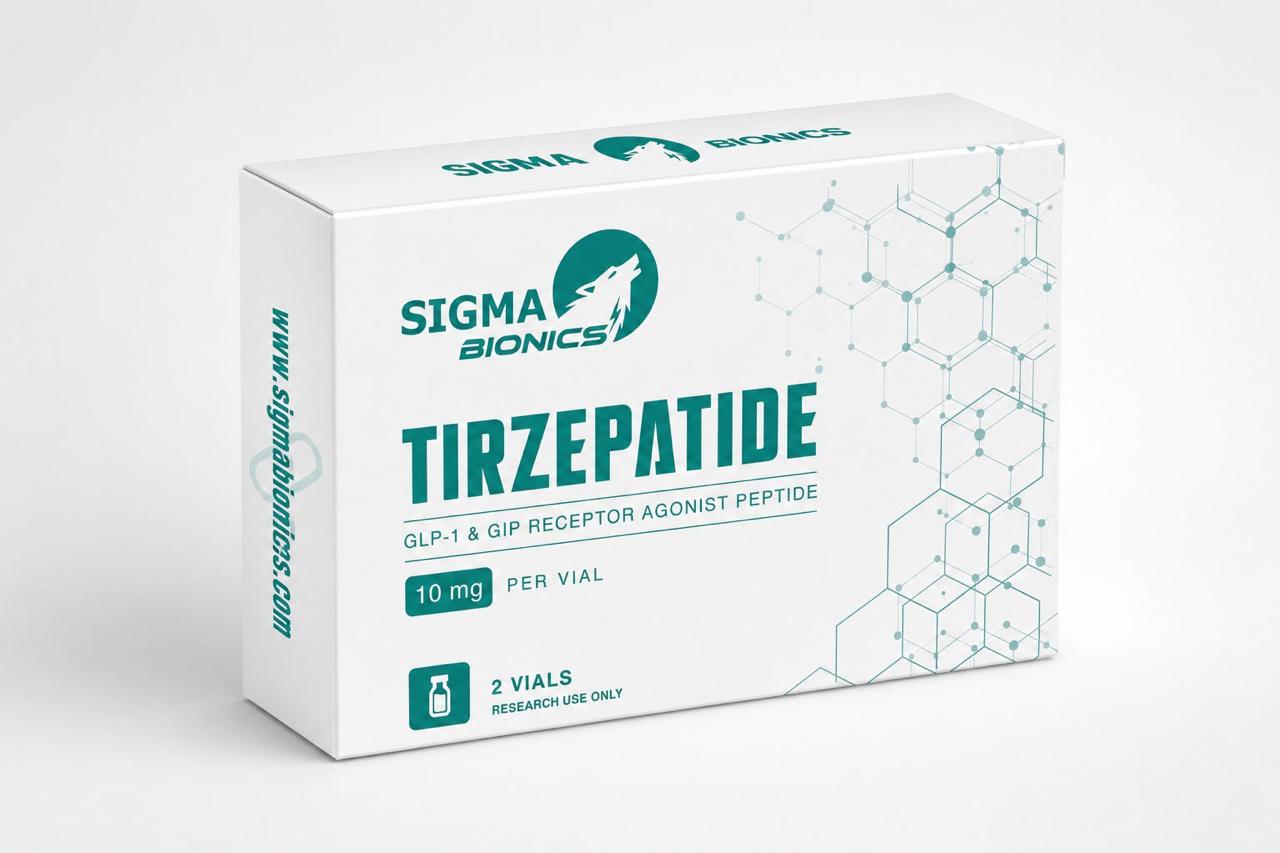
10 mg per vial |
|
Package Size |
2 vials per box |
|
Intended Application |
Laboratory research |
|
Use Classification |
Research Use Only |